

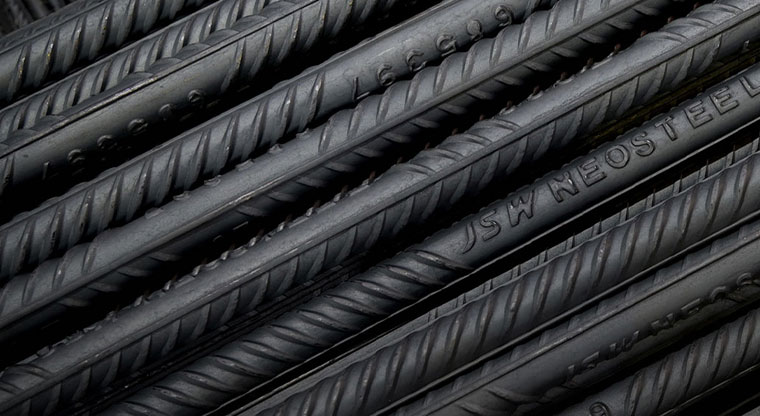
Every reinforced concrete structure in India - from a two-bedroom home to a metro rail viaduct - depends on TMT bars embedded in its concrete. These bars are the steel skeleton that holds the structure together under gravity loads, wind, and seismic forces. But not all TMT bars deliver the same performance. Understanding the qualities of a good TMT bar is the difference between a structure that stands for 80 years and one that shows distress in under a decade.
This guide covers the top 10 qualities that define a good quality TMT bar - the characteristics that engineers specify, quality auditors test, and experienced builders insist on. Use this as your checklist when evaluating TMT bar suppliers, receiving material on site, or understanding what the Mill Test Certificate numbers mean.
Steel is the most expensive material in most construction projects - but the cost of using substandard rebar is orders of magnitude higher than any price saving. A failed RCC column or beam does not just cost money; it costs lives.
The challenge for buyers is that low-quality TMT bars often look identical to good ones on the surface. Differences in chemistry, microstructure, and mechanical properties are invisible to the naked eye. This is why understanding the defining qualities of a good TMT bar - and how to verify them - is essential knowledge for any serious builder or procurement professional.
The challenge for buyers is that low-quality TMT bars often look identical to good ones on the surface. Differences in chemistry, microstructure, and mechanical properties are invisible to the naked eye. This is why understanding the defining qualities of a good TMT bar - and how to verify them - is essential knowledge for any serious builder or procurement professional.
Choosing the right TMT bar is critical to the safety and longevity of any structure. While grades and pricing are often the focus, true quality comes down to a combination of mechanical properties, chemical composition, and verifiable standards. Here’s a practical breakdown of what to look for.
Yield strength determines how much load a bar can carry before deforming permanently. A good TMT bar not only meets IS 1786 minimums but delivers consistent strength across batches. Variations within the same lot can lead to unpredictable structural behaviour, which is a risk no project should take.
What to check: Review the Mill Test Certificate (MTC). Yield strength should exceed the minimum requirement by a healthy margin and remain consistent across the batch.
Ductility allows steel to bend rather than break, which is especially critical in seismic zones. Higher elongation ensures the structure can absorb energy and provide warning before failure.
What to check: MTC values for elongation. For example, Fe 500 should meet at least 12 percent, while Fe 500D should reach 16 percent or more.
The chemistry of steel directly impacts weldability, strength, and corrosion resistance. Lower levels of carbon, sulphur, and phosphorus generally indicate better quality and performance.
What to check: MTC chemical analysis. Lower-than-maximum values are a good sign of tighter process control.
The rib design ensures proper bonding between steel and concrete. Poorly defined or irregular ribs weaken this bond and reduce structural performance.
What to check: Visual inspection. Ribs should be uniform, well-defined, and consistent along the entire length.
Underweight bars reduce actual steel content and compromise load-bearing capacity, even if they look identical.
What to check: Weigh a one-metre sample and compare with standard values. Deviations beyond acceptable limits should be rejected.
In harsh environments, corrosion can weaken reinforcement and damage concrete. Quality TMT bars resist this through better chemistry and surface integrity.
What to check: Look for deep rust, pitting, or surface defects. Light rust is acceptable, but heavy damage is not.
A higher ratio indicates better energy absorption and performance under stress, particularly during seismic events.
What to check: Calculate from MTC values. Higher ratios signal better ductility and resilience.
Good weldability ensures easier fabrication and stronger joints without complex procedures.
What to check: Carbon equivalency (CE) values in the MTC. Lower values indicate better weldability.
TMT bars should bend without cracking, especially during on-site fabrication.
What to check: Perform a bend test. Any visible cracks are a clear rejection criterion.
Finally, no quality check is complete without proper documentation. Certification ensures the material meets national standards and can be traced back to its source.
What to check: BIS marking rolled into the bar and a matching MTC with heat number. Without these, quality cannot be guaranteed.
Before accepting a delivery, a simple on-site check can help you catch quality issues early and avoid costly mistakes later.
Start with surface markings. The IS 1786 grade, such as Fe 550D, should be rolled directly into the bar, not just printed on a tag. This is your first indicator of authenticity.
Next, look closely at the rib pattern. Hold a one-metre sample and check along its length. The ribs should be uniform, well-defined, and consistent from end to end, as they play a key role in bonding with concrete.
A weight check is equally important. Weigh a one-metre sample and compare it with standard values. Any deviation beyond 3 percent is a clear sign to reject the material.
Check for surface condition as well. Light rust is normal, but heavy flaking, pitting, or a blackened surface can indicate deeper quality issues.
Then assess straightness. Hold the bar horizontally and ensure there is no visible bending or warping, which often points to poor handling or storage.
If possible, perform a bend test. Bending the bar 180 degrees around the specified mandrel should not cause surface cracks. This confirms ductility and strength.
Finally, verify the documentation. The heat number on the Mill Test Certificate must match the number on the bundle tag. Both should be present and clearly traceable.
When it comes to TMT bars, even a single quality lapse can have serious consequences. That’s why it’s important to stay alert to warning signs at the time of delivery.
Be cautious if the IS 1786 mark appears only on paper tags and not rolled into the bar itself, or if the ribs look irregular or poorly defined. Weight deviations beyond acceptable limits, especially more than 3 percent below standard, are another clear concern. Visible issues like heavy pitting or flaking rust can also indicate compromised quality.
Equally important is documentation. If the supplier cannot provide a Mill Test Certificate (MTC), or if the heat number on the MTC does not match the delivered material, it’s a strong signal to step back.
Any one of these red flags is reason enough to reject the material or insist on independent testing before use
In construction, quality isn’t something you inspect once - it’s something you build in from the very start. That’s why every builder, contractor, and procurement manager should insist on checking all critical quality parameters, not just the ones that are easy to verify at the site gate.
Taking the time to validate material quality during procurement can prevent far bigger issues later, from structural weaknesses to costly rework. In that sense, investing in proper quality checks upfront isn’t an added expense - it’s one of the most effective ways to ensure long-term safety and performance.
View All Blogs


